Crypto license by country: how to get one
A crypto license is issued by the financial regulator of the country a business operates from, under that country's own statute, and whether one is needed at all depends on the regime. Of the 34 jurisdictions we track, 13 run a licensing regime, 7 run a registration regime, 10 are EU or EEA states under MiCA, 3 have no dedicated framework and 1 has a regime in force that nobody can be authorised under. Each guide names the regulator and the framework, quotes the published costs and timelines or says that none are published, and lists the steps from incorporation to register entry.
27 of the 34 guides are fully researched; the rest state their regulator and framework and fill in as research is reviewed, built from regulator publications and statute text rather than sales pages. Fees move: check any figure against the regulator before you budget.
How a crypto license is obtained
The 34 guides record the application as the stages below. The count beside each is how many guides include it, so a stage every regulator runs shows a high number and one that only some regimes have, such as an annual renewal, shows a low one.
Classify the activity
Which class, tier or regulator the business falls under, before anything else.
18 of 34 guides: Australia, Barbados, Cape Verde and 15 more
Incorporate a local company
An entity in the jurisdiction, formed before anything is filed.
23 of 34 guides: Bahamas, Barbados, Bosnia and Herzegovina and 20 more
Build the application file
Directors, capital, AML controls, banking and the documents the regulator lists.
26 of 34 guides: Australia, Bahamas, Barbados and 23 more
File with the regulator
The application itself, with its fee where one is published.
28 of 34 guides: Australia, Bahamas, Barbados and 25 more
Completeness check and assessment
The regulator confirms the file is complete, then reviews it.
26 of 34 guides: Bahamas, Cape Verde, Cayman Islands and 23 more
Authorisation and register entry
The grant, the entry on the public register, and any passporting or mobilisation conditions.
25 of 34 guides: Australia, Bahamas, Cape Verde and 22 more
Renew and pay the annual fee
Where the regime charges by the year, the date it falls due.
5 of 34 guides: Bahamas, El Salvador, Seychelles and 2 more
Every jurisdiction compared
Regime, regulator, the honest cost story and the time to a decision, each in the terms its own guide records. Alphabetical by country.
| Jurisdiction | Regime | Regulator | Cost | Time to license |
|---|---|---|---|---|
 Crypto License in Australia (2026) Crypto License in Australia (2026) | Licensing regimeAUSTRAC registration today, ASIC licensing from April 2027 | AUSTRAC and the Australian Securities and Investments Commission (ASIC)Corporations Amendment (Digital Assets Framework) Act (2026) | AUSTRAC registration is free. The AFS licence is where the money goes, and the real cost is the compliance and documentation build rather than a lodgement fee. ASIC publishes its own fee schedule and it is the smaller number. | The Act commences 9 April 2027, and ASIC has published an implementation roadmap covering the period to that date. An AFS licence application is not a quick process, so a firm intending to hold client assets after commencement should already be in it. |
 Crypto License in the Bahamas (2026) Crypto License in the Bahamas (2026) | Registration regimeRegistration with the Securities Commission under the DARE Act 2024 | Securities Commission of The BahamasDigital Assets and Registered Exchanges Act (2024) | The fees here are the Commission's own published figures, not a consultancy estimate. Budget the registration fee on top of the application fee: an exchange pays USD 6,250 plus USD 18,750 in its first year. Adding an activity to an existing exchange registration costs a further USD 7,500 to apply and USD 6,250 per activity at registration and renewal. | Not recorded |
 Crypto License in Barbados (2026) Crypto License in Barbados (2026) | No dedicated regimeNo crypto license exists yet; FSC VASP framework in consultation | Central Bank of Barbados and the Financial Services CommissionNo dedicated statute | There is no license fee because there is no license. The costs that exist today are incorporation through CAIPO at BDS 750 plus BDS 30 for name reservation, the professional cost of building AML compliance to the 2011 act's standard, and, for payments businesses, the Central Bank's National Payment System Act licensing track. The sandbox publishes no application fee. | Not recorded |
 Crypto License in Bosnia and Herzegovina (2026)In research Crypto License in Bosnia and Herzegovina (2026)In research | Registration regimeRepublika Srpska keeps a register; the Federation and Brcko have none | Komisija za hartije od vrijednosti Republike Srpske, the Securities Commission of Republika Srpska, which acts for that entity onlyZakon o izmjenama i dopunama Zakona o trzistu hartija od vrijednosti (Republika Srpska) (2022) | Neither the Republika Srpska securities market law nor the rulebook on the register states an application fee, an annual fee or a minimum capital. Licensing consultancies quote figures of a few hundred euros for a Bosnian crypto licence. No such figure appears in any primary text read for this draft, and what those pages call a licence is an entry in an evidence register. | A provider must notify the Commission within 30 days of establishment and be entered in the register before it may offer services. Providers already operating when the rulebook took effect had until the end of January 2023 to apply. No statutory deadline for the Commission's own decision was found in the texts read for this draft. |
 Crypto License in Cape Verde (2026)In research Crypto License in Cape Verde (2026)In research | Registration regimeAML registration with the Banco de Cabo Verde (Lei 30/X/2023), no licence or fee stated | Banco de Cabo Verde (BCV)Lei n.o 30/X/2023, de 21 de junho, regulating the provision of services with virtual assets and the establishment of digital banks, with BCV Aviso n.o 2/2024 (2023) | Neither Lei 30/X/2023 nor Aviso 2/2024 states an application fee, an annual fee or a minimum capital. The file has to prove the share capital is held and where the funds came from (Article 3(5)(g)), and every document not issued by a Cape Verdean authority must be apostilled or legalised and, if not in Portuguese, accompanied by a certified and apostilled translation (Article 9), so translation and legalisation are the costs a founder can predict. | Aviso 2/2024 Article 3(9): the Banco de Cabo Verde notifies its decision on an initial registration within 90 days of receiving the file or the further information it requested, and never later than six months after the initial filing; silence past those deadlines counts as tacit refusal (Article 3(11)). Changes to registered elements are decided within 30 days and at most two months. |
 Crypto License in the Cayman Islands (2026) Crypto License in the Cayman Islands (2026) | Licensing regimeCIMA registration or licence; custody and platforms need the licence | Cayman Islands Monetary Authority (CIMA)Virtual Asset (Service Providers) Act (2020) | The number that decides the budget is the grant fee, not the application fee: KYD 30,000 on the grant of a custody licence and KYD 100,000 on the grant of a trading platform licence, against a KYD 1,000 registration application. | CIMA publishes no processing time commitment. The best documented case ran about thirteen months from the application deadline to the grant of a full licence, with conditional approval around six months in, so plan in the region of a year rather than months. |
 Crypto License in Croatia (2026) Crypto License in Croatia (2026) | EU MiCA (CASP)MiCA authorization from HANFA, mandatory since 1 July 2026 | Croatian Financial Services Supervisory Agency (HANFA)EU Markets in Crypto-Assets Regulation (MiCA) (2023) | HANFA does not publish a fee schedule for crypto-asset service provider applications, so the state-side cost of a Croatian license is not a published number. The capital figures are the EU-wide MiCA floors rather than a Croatian charge. Any all-in price you are quoted for a Croatia license is a consultancy's own service pricing, not a regulator tariff, and the quotes in circulation vary by a wide margin. | Not recorded |
 Crypto License in the Czech Republic (2026) Crypto License in the Czech Republic (2026) | EU MiCA (CASP)MiCA authorization from the CNB, 11 granted from 251 assessed | Česká národní banka (Czech National Bank)Zákon o digitalizaci finančního trhu (Act on the Digitalisation of the Financial Market) (2025) | The Czech National Bank does not publish a headline application fee, so the ratio of 11 authorizations to 251 assessed applications is the more useful cost signal: the expense sits in preparing a file that survives review, not in the filing itself. | MiCA allows 25 working days for the completeness check and 40 working days for the assessment. The bank's own record, 11 authorizations from 251 applications assessed, indicates that many files take considerably longer than that or end in refusal. |
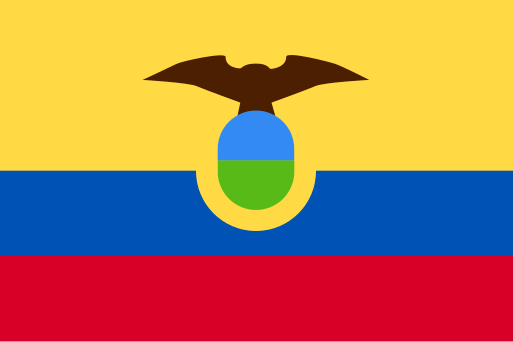 Crypto License in Ecuador (2026) Crypto License in Ecuador (2026) | No dedicated regimeNo crypto license exists; crypto is not an authorized means of payment | Banco Central del Ecuador and the Monetary Policy and Regulation BoardOrganic Monetary and Financial Code (2014) | There is no application fee, no capital floor and no renewal fee, because there is no license to hold. What a crypto business in Ecuador actually pays for is ordinary company formation and the cost of building anti-money-laundering compliance to the standard the UAFE expects of an obligated entity. Neither is priced by a crypto-specific schedule, so any quoted price for an Ecuadorian crypto license is a professional services fee, not a government one. | Not recorded |
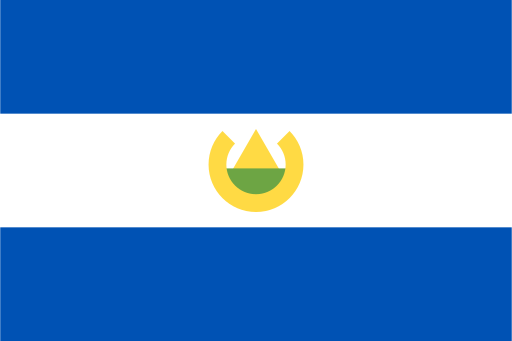 Crypto License in El Salvador (2026) Crypto License in El Salvador (2026) | Licensing regimeCNAD digital asset provider registration, fees set in minimum salaries | Comision Nacional de Activos Digitales (CNAD)Ley de Emision de Activos Digitales (2023) | Both fees are set in minimum salaries rather than dollars, so they rise whenever the commerce and services minimum wage rises. The widely quoted USD 5,475 and USD 3,650 are the figures at the pre-June 2025 wage and are no longer current. | Not recorded |
 Crypto License in Estonia (2026) Crypto License in Estonia (2026) | EU MiCA (CASP)MiCA authorization from Finantsinspektsioon, replacing the FIU licence | Finantsinspektsioon (Estonian Financial Supervision and Resolution Authority)Krüptovaraturu seadus (Crypto-Asset Market Act) (2024) | The EUR 3,000 processing fee is the published number and the small one. Capital, a real office and the compliance build dominate the budget, and none of those are figures the regulator sets or publishes. | MiCA allows 25 working days for the completeness check and 40 working days for the substantive assessment, so about 65 working days once a file is accepted. Producing a file that survives that review is what takes most applicants several months. |
 Crypto License in Finland (2026)In research Crypto License in Finland (2026)In research | EU MiCA (CASP)MiCA CASP authorisation from the FIN-FSA, EUR 8,700 fee, transition ended 30 June 2025 | Financial Supervisory Authority (Finanssivalvonta, FIN-FSA)EU Markets in Crypto-Assets Regulation (MiCA), applied through the Act on Crypto-Asset Service Providers and Markets in Crypto-Assets (402/2024) (2024) | The FIN-FSA's processing fee schedule applying from 1 January 2026 sets EUR 8,700 for a crypto-asset service provider authorisation (65 hours of handling included, EUR 133 per further hour), EUR 3,500 for an Article 60 notification (25 hours), EUR 585 for a cross-border passporting notification and EUR 1,850 for any other MiCA permission or decision. On top of the MiCA Annex IV capital floor, an authorised firm pays the FIN-FSA's annual supervision fee, a statutory levy under the Act on the Financial Supervisory Authority's Supervision Fees (1209/2023) that the FIN-FSA says covers about 90 percent of its funding; the crypto-asset provider basis for that levy was not on the pages read for this draft. | MiCA Article 63 as the FIN-FSA describes it: receipt confirmed within 5 working days, completeness assessed within 25 working days, then 40 working days for the substantive assessment, suspended once for at most 20 working days by the first request for clarification, with the decision notified within 5 working days. The FIN-FSA prices the work at 65 hours. The first authorisations came in 2025, with five granted during that year. |
 Crypto License in Georgia (2026) Crypto License in Georgia (2026) | Registration regimeNBG registration, and a free zone company is not exempt | National Bank of Georgia (NBG)No dedicated statute | The state registration fee is modest by the standards of this comparison and there is no minimum capital for a limited liability company. The real cost is anti-money-laundering compliance, which applies in full and is not reduced by zone status. | The National Bank has a 60 day decision window, extendable once by a further 60 days, so a straightforward application is measured in months rather than the year or more that several jurisdictions here require. |
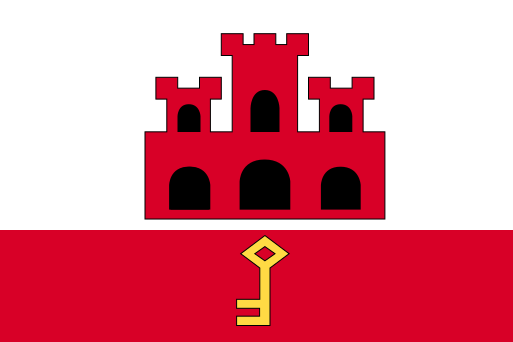 Crypto License in Gibraltar (2026) Crypto License in Gibraltar (2026) | Licensing regimeGFSC DLT provider authorisation, running since 2018 | Gibraltar Financial Services Commission (GFSC)Financial Services (Distributed Ledger Technology Providers) Regulations (2018) | The most commonly repeated error about Gibraltar is treating the GBP 12,254 annual fee as an application fee. It is not: applications are banded at GBP 10,000, GBP 20,000 or GBP 30,000 by complexity, and the GBP 12,254 recurs every year thereafter. | The GFSC targets a maximum of nine months across the first three application stages, followed by a mobilisation stage of normally three to six months, so plan for roughly twelve to fifteen months to full authorisation. |
 Crypto License in Hong Kong (2026) Crypto License in Hong Kong (2026) | Licensing regimeSFC platform licence; 13 hold one and several have withdrawn | Securities and Futures Commission (SFC)Anti-Money Laundering and Counter-Terrorist Financing Ordinance (2023) | The capital floor is modest for a financial centre of this size, so the cost that decides feasibility is the operational one: custody arrangements, insurance, local staffing and the twelve month liquidity buffer that cannot be met with crypto. | Not recorded |
 Crypto License in Latvia (2026) Crypto License in Latvia (2026) | EU MiCA (CASP)MiCA authorization from Latvijas Banka, the first crypto regime | Latvijas Banka (Bank of Latvia)Crypto-Asset Service Law (2024) | The EUR 2,500 application fee is published by Latvijas Banka and is genuinely low, but it is not the number that decides a budget. Capital, the compliance build and the ongoing supervision fee all matter more. | MiCA allows 25 working days for a completeness check and 40 working days for the decision that follows. Latvijas Banka's pre-application stage sits ahead of that clock, so plan for months rather than weeks from first contact to authorization. |
 Crypto License in Lithuania (2026) Crypto License in Lithuania (2026) | EU MiCA (CASP)MiCA authorization from the Bank of Lithuania after a hard cutoff | Lietuvos bankas (Bank of Lithuania)Law on Markets in Crypto-Assets (2024) | Because the Bank of Lithuania publishes no authorization fee, any figure quoted for one is an adviser's estimate rather than a charge set by the regulator. The capital floors and the compliance build are the costs that can be stated with confidence. | MiCA allows 25 working days for the completeness check and 40 working days for the assessment. The Bank of Lithuania stated publicly that many applications filed in 2025 fell short of the minimum requirements, which is what stretches real timelines. |
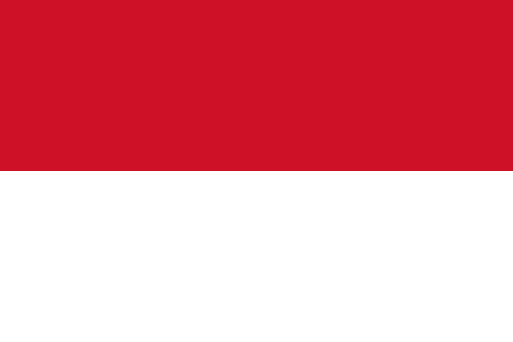 Crypto License in Monaco (2026)In research Crypto License in Monaco (2026)In research | Licensing regimePrior agrement from the Minister of State, or the CCAF for financial tokens | Minister of State, with the Commission de Controle des Activites Financieres (CCAF) for financial-token servicesLoi n. 1.528 du 7 juillet 2022 portant modification de diverses dispositions en matiere de numerique et reglementation des activites des prestataires de services sur actifs numeriques ou sur crypto-actifs (2022) | The checked statute and public CCAF materials do not publish an application fee, an annual supervision fee, or a class-specific fee. The statute delegates own-funds amounts and application details to Ordonnance Souveraine. | The statutory decision deadline is not stated in Loi n. 1.528. Article 15 delegates the deadline to Ordonnance Souveraine, and silence after that period counts as rejection. Observed processing practice was not reported in the primary sources checked. |
 Crypto License in Montenegro (2026)In research Crypto License in Montenegro (2026)In research | Registration regimeAML-law register entry with the Capital Market Authority, EUR 5,000 fee, no licence | Capital Market Authority of Montenegro (Komisija za trziste kapitala Crne Gore, CMA)Law on the Prevention of Money Laundering and Terrorist Financing, Articles 40a to 40r (crypto-asset services) (2025) | The only published official figure is the EUR 5,000 registration fee in Article 14 of the Capital Market Authority's fee schedule applying from 1 July 2026. Article 40b of the Law sets no minimum capital and the schedule sets no annual fee for crypto-asset providers. The file is delivered physically (Rulebook, Article 8) with notarised statements, criminal-record extracts and a beneficial-owner register extract, so budget for notary and translation costs, which no authority publishes. | Not recorded |
 Crypto License in Norway (2026)In research Crypto License in Norway (2026)In research | EU MiCA (CASP)MiCA CASP authorisation from Finanstilsynet via the EEA, transition ended 30 June 2026 | Finanstilsynet (Financial Supervisory Authority of Norway)EU Markets in Crypto-Assets Regulation (MiCA), applied through the Act on Crypto-Assets (kryptoeiendelsloven, Act of 27 May 2025 No. 20) (2025) | Finanstilsynet publishes no application fee for a CASP authorisation: neither its CASP application page nor the Altinn form KRT-3060 names one. The published cost is the MiCA Annex IV capital floor for the class of services applied for, EUR 50,000, EUR 125,000 or EUR 150,000. Finanstilsynet also funds itself through an annual levy on supervised entities; the 2026 allocation notice could not be fetched for this draft, so no figure is quoted. | MiCA Article 63 as Finanstilsynet describes it: receipt confirmed within 5 working days, completeness assessed within 25 working days, then a 40 working day assessment with one further-information request of up to 20 working days, and the decision notified within 5 working days. In practice the first Article 63 authorisation came on 18 May 2026, ten and a half months after the Act applied. |
 Crypto License in Panama (2026) Crypto License in Panama (2026) | No dedicated regimeNo crypto license exists; the bills that would create one keep stalling | Unidad de Analisis Financiero and the Superintendencia de Bancos de PanamaLaw 23 of 2015 on money laundering prevention (2015) | There is no license fee, because there is no license. The real costs are incorporating a sociedad anonima and obtaining the Aviso de Operacion, the professional cost of working out whether any existing obligated-subject category catches the business, and the time spent securing a bank account. Any quoted price for a Panama crypto license is a price for those services with a misleading label on it. | Not recorded |
 Crypto License in Poland (2026) Crypto License in Poland (2026) | Regime not in forceMiCA applies, but no CASP authorisation is obtainable | Komisja Nadzoru Finansowego (Polish Financial Supervision Authority, KNF)No dedicated statute | There is no application fee because there is no application. The cost of operating in Poland today is the cost of authorisation in another member state, plus the passporting notification. | Not recorded |
 Crypto License in Serbia (2026) Crypto License in Serbia (2026) | Licensing regimeDual licensing: NBS for virtual currencies, SEC Serbia for tokens | National Bank of Serbia and the Securities CommissionLaw on Digital Assets (2020) | Neither the National Bank of Serbia nor the Securities Commission publishes a fee schedule or a minimum capital figure for digital asset service providers, so budget for professional advice and confirm any quoted number with the authority you will apply to. | Not recorded |
 Crypto License in the Seychelles (2026) Crypto License in the Seychelles (2026) | Licensing regimeFSA licenses four VASP categories under the 2024 Act | Financial Services Authority (FSA) SeychellesVirtual Asset Service Providers Act (2024) | Every fee here comes from the Second Schedule of Act 12 of 2024, so each line is checkable in the gazetted PDF. The US dollar equivalents are approximate, at about SCR 14 to USD 1 in August 2026, and they move with the rupee. A quote that does not match the statutory numbers is bundling professional fees into the total. | Not recorded |
 Crypto License in Singapore (2026) Crypto License in Singapore (2026) | Licensing regimeMAS payment institution licence; 37 hold one for crypto | Monetary Authority of Singapore (MAS)Payment Services Act (2019) | Singapore inverts the usual cost shape: the fee is among the lowest here and the process among the most expensive, because the cost is the compliance build and the year or more of review rather than anything payable to MAS. | MAS states the current waiting period is more than a year and that it cannot give a better estimate. Budget twelve to twenty four months, and note that MAS may put an application judged not ready for review on hold for a further six months. |
 Crypto License in Slovakia (2026) Crypto License in Slovakia (2026) | EU MiCA (CASP)MiCA CASP authorization from the National Bank of Slovakia | National Bank of Slovakia (NBS)EU Markets in Crypto-Assets Regulation (2023) | MiCA fixes the capital floors EU-wide, so those figures are identical in every member state and are not something a Slovak adviser can negotiate. NBS publishes no flat application fee for the permit itself. The numbers you will see advertised, roughly EUR 16,600 to EUR 56,200, are consultancy service packages including company formation, which is why they differ by more than three times: the cost is legal, compliance and audit work, not a license price. | NBS confirms completeness within 25 working days. Published figures for the decision itself differ, with 40 and 65 working days both in circulation, so confirm the current period with NBS. Four to six months end to end is the realistic planning figure. |
 Crypto License in Slovenia (2026) Crypto License in Slovenia (2026) | EU MiCA (CASP)EU MiCA: ATVP authorizes CASPs, Banka Slovenije e-money tokens | Securities Market Agency (ATVP) and Banka SlovenijeEU Markets in Crypto-Assets Regulation (MiCA) (2023) | The capital floors are EU law and identical across every MiCA member state, so a Slovenia-specific figure that differs from EUR 50,000, EUR 125,000 or EUR 150,000 is simply wrong. Fees are the softer number. Figures circulating for a Slovenian CASP application range from roughly EUR 5,000 to EUR 25,000, but those are licensing consultancies pricing their own packages rather than a published ATVP tariff, so confirm the supervisory fee with the ATVP before you budget against them. | 25 working days for the ATVP to confirm the application is complete, then a 40 working day substantive assessment under MiCA Article 63; allow four to five months end to end once information requests are counted |
 Crypto License in Spain (2026)In research Crypto License in Spain (2026)In research | EU MiCA (CASP)MiCA CASP authorisation from the CNMV; the 18-month transition ended 1 July 2026 | Comision Nacional del Mercado de Valores (CNMV)EU Markets in Crypto-Assets Regulation (MiCA), with the CNMV designated under Article 251 of Ley 6/2023 de los Mercados de Valores y de los Servicios de Inversion (2023) | The CNMV publishes no application fee for a CASP authorisation: Ley 16/2014, which sets every CNMV fee, has no line for crypto-asset service providers in the consolidated text read for this draft. The published cost is therefore the MiCA Annex IV capital floor for the class of services, EUR 50,000, EUR 125,000 or EUR 150,000, plus the professional cost of a file the CNMV's own application manual describes; that manual was marked 'under review' on the CNMV's forms page on 6 September 2026. | MiCA Article 63: receipt acknowledged within 5 working days, completeness assessed within 25 working days, then a 40 working day assessment of the complete file, with the decision notified within 5 working days. No Spanish practice figure is published; the CNMV's own MiCA page calls the authorisation a demanding process and points applicants to ESMA's supervisory briefing. |
 Crypto License in St. Lucia (2026) Crypto License in St. Lucia (2026) | Licensing regimeFSRA licensing under the Virtual Asset Business Act, No. 24 of 2022 | Financial Services Regulatory Authority (FSRA)Virtual Asset Business Act (2022) | The FSRA does not publish a fee schedule, a capital table or a renewal fee for virtual asset licenses, and the five-class breakdown itself is documented by advisers rather than by the regulator. Every figure quoted online therefore comes from a licensing adviser, and as of August 2026 those quotes disagree by roughly an order of magnitude: application fees from XCD 1,000 (about USD 370) to USD 5,000 per class, annual fees from XCD 15,000 (about USD 5,600) to USD 20,000, and minimum capital from XCD 100,000 to XCD 1,300,000 (about USD 37,000 to USD 480,000) depending on class. Budget from none of them. Ask the FSRA for the current schedule in writing, and add company registration, compliance drafting and the fit and proper file on top of whatever the government charge turns out to be. | Not published by the FSRA |
 Crypto License in St. Vincent and the Grenadines (2026) Crypto License in St. Vincent and the Grenadines (2026) | Registration regimeFSA registration mandatory since 31 May 2025 (Virtual Asset Business Act) | Financial Services Authority (FSA)Virtual Asset Business Act (2022) | The FSA's published fees come to EC$16,000 in the first year, about USD 5,900 at the East Caribbean dollar's fixed peg of EC$2.70 to USD 1: EC$4,000 to apply and EC$12,000 on registration, then EC$12,000 every 31 January. The statutory deposit is the larger commitment and is not a fee: 25 percent of total client financial obligations, or EC$100,000 for an applicant with no client record yet, lodged with the Authority. Local counsel and compliance work sit on top, and no official figure exists for those. | Not published. The FSA does not advertise a decision turnaround for virtual asset business registrations. |
 Crypto License in Switzerland (2026) Crypto License in Switzerland (2026) | Licensing regimeNo crypto licence exists; four other routes do, depending on scale | Swiss Financial Market Supervisory Authority (FINMA)No dedicated statute | SRO membership is an order of magnitude cheaper than a FINMA licence, which is the main reason most Swiss crypto firms sit at that tier. SRO schedules separate a one-off admission fee, an annual membership contribution and per-file charges, so a single quoted number rarely reflects what a firm actually pays. | Not recorded |
 Crypto License in the United Arab Emirates (2026) Crypto License in the United Arab Emirates (2026) | Licensing regimeFive regulators; which one applies depends on where you set up | Virtual Assets Regulatory Authority (VARA) for Dubai, plus four othersDubai Law No. 4 of 2022 Regulating Virtual Assets (2022) | The headline application fee understates the running cost, because annual supervision is twice the application fee and is charged per activity at full rate, while additional activities are discounted only at application. Budget the annual figure, not the entry figure. | Four to seven months is a realistic range for a VARA licence, and the domestic bank account is usually the step that decides where in that range you land rather than the regulator's own review. |
 Crypto License in the United Kingdom (2026) Crypto License in the United Kingdom (2026) | Registration regimeMLR registration today, FSMA authorisation from October 2027 | Financial Conduct Authority (FCA)No dedicated statute | The application fee is not the constraint. The constraint is that the window is five months long and closes on 28 February 2027, and that preparing an authorisation application is a materially bigger undertaking than the registration that preceded it. | The gateway opens 30 September 2026 and closes 28 February 2027, with the mandatory regime commencing 25 October 2027. Firms intending to operate after that date should be preparing now rather than when the window opens. |
 Crypto License in Uzbekistan (2026) Crypto License in Uzbekistan (2026) | Licensing regimeNAPP licenses four crypto activities, mining only registers | National Agency of Perspective Projects (NAPP)Presidential Decree UP-121 on crypto-asset turnover (2022) | Uzbek license fees are published only as multiples of the base calculation value (BCV), so the som and dollar amounts here are conversions rather than figures NAPP prints. The BCV has been UZS 412,000 since 1 August 2025 and rises to UZS 440,000 on 1 September 2026, lifting every fee by about 6.8 percent on that date. Dollar equivalents use roughly 11,900 UZS to the US dollar, the rate through August 2026. | Not recorded |
"Not recorded" means the guide carries no figure for that cell. It does not mean the regulator publishes none: where a guide has checked and found nothing published, the cell says so in those words.
Crypto license in Europe: MiCA and the rest of the continent
10 of the 18 European jurisdictions we track are EU member states, where the license is a crypto-asset service provider authorisation under the Markets in Crypto-Assets Regulation, issued by the national competent authority. Each guide records that authority and the application fee it publishes, or that it publishes none.
| Member state | National competent authority | Application fee |
|---|---|---|
| Crypto License in Croatia (2026) | Croatian Financial Services Supervisory Agency (HANFA) | Not recorded |
| Crypto License in the Czech Republic (2026) | Česká národní banka (Czech National Bank) | Not recorded |
| Crypto License in Estonia (2026) | Finantsinspektsioon (Estonian Financial Supervision and Resolution Authority) | EUR 3,000 processing fee, published by Finantsinspektsioon |
| Crypto License in Finland (2026) | Financial Supervisory Authority (Finanssivalvonta, FIN-FSA) | EUR 8,700 for a CASP authorisation, plus EUR 133 per hour beyond 65 hours of handling; EUR 3,500 for an Article 60 notification, plus the hourly rate beyond 25 hours (FIN-FSA fee schedule from 1 January 2026) |
| Crypto License in Latvia (2026) | Latvijas Banka (Bank of Latvia) | EUR 2,500 for reviewing an authorization application, published by Latvijas Banka |
| Crypto License in Lithuania (2026) | Lietuvos bankas (Bank of Lithuania) | The Bank of Lithuania does not publish a fee schedule for crypto-asset service provider authorization |
| Crypto License in Norway (2026) | Finanstilsynet (Financial Supervisory Authority of Norway) | None stated on Finanstilsynet's CASP application page or the Altinn form KRT-3060, as read on 6 September 2026 |
| Crypto License in Slovakia (2026) | National Bank of Slovakia (NBS) | No flat government fee is published by NBS |
| Crypto License in Slovenia (2026) | Securities Market Agency (ATVP) and Banka Slovenije | Not recorded |
| Crypto License in Spain (2026) | Comision Nacional del Mercado de Valores (CNMV) | Not published: Ley 16/2014, the CNMV's fee law as consolidated on BOE, carries no fee line for crypto-asset service provider authorisation, as read on 6 September 2026 |
The MiCA class table, identical in all 10
The capital floors are set EU-wide, so every member state guide carries the same table. What differs by state is the authority, its fee and its transition deadline, which is what each guide is about.
| Class | Covers | Minimum capital |
|---|---|---|
| Class 1 | Reception and transmission of orders, execution of orders on behalf of clients, placing of crypto-assets, transfer services on behalf of clients, advice on crypto-assets, portfolio management of crypto-assets | EUR 50,000 |
| Class 2 | Custody and administration of crypto-assets on behalf of clients, exchange of crypto-assets for funds, exchange of crypto-assets for other crypto-assets | EUR 125,000 |
| Class 3 | Operation of a trading platform for crypto-assets | EUR 150,000 |
Where MiCA applies but no authorisation can be obtained
- Crypto License in Poland (2026)
MiCA applies, but no CASP authorisation is obtainable.
Any page offering a Polish crypto licence is selling something that cannot be issued. KNF has no power to grant a CASP authorisation, and the transitional cover for the old register ended on 1 July 2026.
European jurisdictions outside MiCA
7 European jurisdictions we track sit outside the EU regime and run a framework of their own.
- Crypto License in Bosnia and Herzegovina (2026)Registration regimeRepublika Srpska keeps a register; the Federation and Brcko have none
- Crypto License in Gibraltar (2026)Licensing regimeGFSC DLT provider authorisation, running since 2018
- Crypto License in Monaco (2026)Licensing regimePrior agrement from the Minister of State, or the CCAF for financial tokens
- Crypto License in Montenegro (2026)Registration regimeAML-law register entry with the Capital Market Authority, EUR 5,000 fee, no licence
- Crypto License in Serbia (2026)Licensing regimeDual licensing: NBS for virtual currencies, SEC Serbia for tokens
- Crypto License in Switzerland (2026)Licensing regimeNo crypto licence exists; four other routes do, depending on scale
- Crypto License in the United Kingdom (2026)Registration regimeMLR registration today, FSMA authorisation from October 2027
How to actually compare jurisdictions
The regime type is the first filter: a licensing act with capital requirements, a registration regime that mostly means AML supervision, the EU's shared MiCA authorization, or no framework at all. After that the questions that decide real projects are boring and practical. What does the regulator require in local substance, directors and staff? What are the published fees and the unpublished professional costs? How long do applications actually take, not how long does the statute promise? And will a bank open an account for a company licensed there?
One warning applies everywhere: licensing consultancies rank highly in search for every one of these countries, and some of them advertise licenses that do not exist. Barbados is the clearest case, where a "DASP license" is marketed for a country whose framework is still at the consultation stage. Every fact on our pages links to the regulator or the statute so you can check it yourself.
Planning a license application?
Tell us what you are building and where you want to operate, and we will point you at the right starting documents for your shortlist and, where we know one, a consultant or law firm with real experience in that jurisdiction. The pointer costs nothing; we may earn a referral fee if you engage a provider we introduce.
Frequently asked questions
What is a crypto license?
Authorization from a country's financial regulator to run a crypto business: an exchange, a custodian, a broker, or a payments service. What it is called and what it costs varies completely by jurisdiction. Some countries run full licensing acts with capital requirements, some only register businesses for AML supervision, EU members share one authorization under MiCA, and some countries have no framework at all.
How long does it take to get a crypto license?
21 of the 34 guides on this page record a timeline from application to decision, quoted in the comparison table in the regulator's own terms; the others say where the regulator publishes none. The statutory window and the observed practice are often different numbers, and each guide gives both where both are known.
Which country has the cheapest crypto license?
Be suspicious of any site that answers this with a single confident number. Headline government fees are the smallest part of the real cost: minimum capital, local substance (directors, offices, compliance staff), professional fees and time dominate, and they shift with every amendment. Our per-country pages carry the official figures with sources and dates where the regulator publishes them, and say so where it does not.
Do EU countries still issue their own national crypto licenses?
No. The EU's Markets in Crypto-Assets Regulation (MiCA) replaced national regimes: crypto-asset service providers now need one CASP authorization from their home regulator, valid across the EU. National transition windows for legacy registrations have been closing country by country since 2025, which is why the EU entries on this page point at MiCA rather than an older national license.
Can I run a crypto business from a country with no framework?
Sometimes, but no framework does not mean no law. General company, AML, securities and payments law still applies, banks still ask what license you hold, and other countries where your customers live still apply their own rules to you. The honest read of a no-framework jurisdiction is on each page, including what regulators there have said is coming.
The other side of the market
These pages are for operators. If you are here to buy bitcoin rather than sell it, every jurisdiction above also has a buying guide: all 232 country guides cover exchanges, payment methods and legality for residents, and the glossary explains the vocabulary regulators use.