Bitcoin in Tunisia: what is actually allowed
- Status
- Banned
- Currency
- Tunisian dinar (TND)
- Last reviewed
- 2026-08-12
Bitcoin access is banned in Tunisia
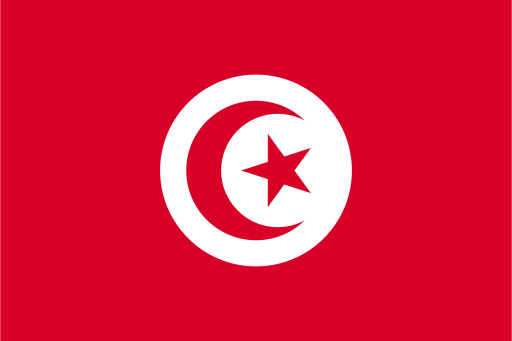
Tunisia bans cryptocurrency, and buying bitcoin there means breaking the law as it stands: since 2018 the Central Bank of Tunisia has prohibited virtual currency dealings, and unauthorized foreign exchange activity is a criminal offense that has been applied to crypto users. The rules have real teeth; in 2021 a teenager was jailed over a small crypto transaction, a case that pushed ministers to promise decriminalization, though the promises have never become law. Tunisian banks block card payments to exchanges, and no licensed platform serves the country. People still trade informally through P2P channels, but that stacks criminal, counterparty, and scam risk on top of each other. This page sets out the legal reality rather than an easy path that does not exist.
What the law says
Cryptocurrency is effectively banned in Tunisia. The Central Bank of Tunisia prohibited virtual currency dealings in 2018, and the country's foreign exchange code treats unauthorized currency dealing as a criminal offense punishable by imprisonment, a framework that has been applied to crypto users, most visibly in the 2021 jailing of a teenager over a small transaction. Officials have repeatedly promised decriminalization, but no reform has passed.
Words worth knowing to read this page
Picked from what this page already says about Tunisia, not from a standard list.
- Cryptocurrency banlegal status: bannedA cryptocurrency ban is a government prohibition on some or all bitcoin activity, ranging from a blanket criminal ban to a narrower order cutting banks off from exchanges.
- Non-custodial walletno venue we rate serves this marketNon-custodial wallets hold your keys on your own device, which means no company can freeze your bitcoin, reverse a payment, or restore access when you lose the backup.
- Chain analysisrestricted marketChain analysis is the practice of reading the public ledger to group addresses into wallets and attach real names to them, using clustering heuristics plus data from exchanges.
- No-KYC exchangeno local rails listedA no-KYC exchange sells bitcoin without collecting your identity documents, which is legal in some places, prosecutable in others, and always a trade of price and recourse for privacy.
Frequently asked questions
Is bitcoin legal in Tunisia?
No. The Central Bank of Tunisia banned virtual currency dealings in 2018, and Tunisia's strict foreign exchange laws make unauthorized currency dealing a criminal offense. Banks are barred from processing crypto transactions, and cards are blocked for exchange payments.
Has anyone actually been prosecuted over crypto in Tunisia?
Yes. The best-known case came in 2021, when a 17-year-old was jailed over a small crypto transaction. The backlash prompted the finance minister to say bitcoin ownership should be decriminalized, but the law has not changed.
Will Tunisia legalize bitcoin?
It has been promised repeatedly since 2021, and draft proposals for decriminalization and licensing have circulated, while the central bank runs a fintech sandbox for supervised experiments. Until a law actually passes, the ban and its criminal penalties remain in force.
What should Tunisians who already hold bitcoin know?
Holding coins securely is the one universally sensible step: self-custody in a wallet you control, with the seed phrase offline, protects against exchange freezes and scams. Selling or converting into dinars is where the legal exposure under the exchange code is sharpest.