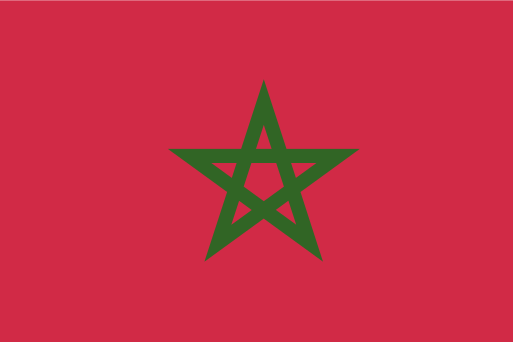
How to buy bitcoin in Morocco
- Status
- Unclear
- Currency
- Moroccan dirham (MAD)
- Recommended
- 2 exchanges
- Last reviewed
- 2026-08-20
Morocco sits in a strange in-between: a 2017 ban on crypto transactions technically remains in force, yet Moroccans are among Africa's most active bitcoin users, and a draft law to legalize and regulate the market is moving through the legislative process. Until it passes, buying happens in a tolerated gray zone. Binance is the platform most Moroccans use, Coinmama handles card purchases where cards work, and Binance's P2P market supports the bank transfer trades that dominate because local banks often block card payments to exchanges. Bank Al-Maghrib, the central bank, drafted Bill 42.25 to bring the market under supervision; until it is law, you trade without legal protection and formal penalties still exist.
Best exchanges in Morocco
Ranked by our editorial review of fees, security record, and local payment support. Rankings are never sold.
The full comparison for Morocco sets the security record and rail count of each platform beside its fees.
| # | Exchange | Rating | Fees | ID check | Pay with | Visit or read the review |
|---|---|---|---|---|---|---|
| 1 | Binance | 4.2 | From 0.1% spot, maker and taker | Required | Visit | |
| 2 | Coinmama | 3.9 | Commission plus card surcharge | Required | Visit |


Some Visit buttons above are referral links: signing up through them is credited to us and may earn a commission, at no extra cost to you. Which platforms pay makes no difference to the ranking.
Why these picks
1. Binance The largest crypto exchange by volume: the deepest bitcoin liquidity anywhere, the lowest headline spot fee of any major platform, and quarterly proof of reserves, under a settled US case and an independent monitor.
Credit or debit card: often blocked by local banks
2. Coinmama A card-first broker that sends bitcoin straight to your own wallet instead of holding it for you.
Credit or debit card: often blocked by local banks
Payment methods in Morocco
The rails local buyers actually use, under their local names. Support varies by exchange; the list above shows exactly which methods each one takes here.
- P2P bank transfer tradesPrimary
often blocked by local banks
- Cash trades via local brokers
Bitcoin wallets available in Morocco
A wallet is where bitcoin lives after you buy it, which is the opposite of the exchanges above: those sell it, these hold it. Availability below is the maker's own published shipping or eligibility policy.

Desktop and browser


Compare every wallet, including the ones we tell you not to buy
Watch: how to buy bitcoin in Morocco
A video walkthrough of buying bitcoin in Morocco: picking an exchange that takes Moroccan dirham deposits, passing verification, and moving your coins to self custody.

From our YouTube channel @dontgetrekt, uploaded 2023-02-09.
Do you need a VPN?
A VPN hides which sites you visit from the network you are on and from your internet provider, which is worth having when you move money over a connection you do not control. It does not get you past an exchange's identity checks: every platform we list verifies who you are no matter where you connect from.
If you want one, the strongest records on our list belong to NordVPN (6 independent no-logs audits, the most of any service we review), Windscribe (its no-logs claim tested in the real world 3 times) and Proton VPN (the most audited service with a free tier).
Buying bitcoin in Morocco, start to finish
Pick a platform and verify your identity
Choose from the table above and complete KYC verification with a photo ID. Regulated platforms in Morocco require this before you can deposit.
Fund your account with P2P bank transfer trades
Common options here: P2P bank transfer trades, credit or debit card, cash trades via local brokers. Bank transfers are usually the cheapest; cards are faster but add fees.
Buy, then decide where to keep it
Place your order, and for anything more than pocket money consider moving it to a hardware wallet you control. Our security guide covers the habits that keep coins safe.
Legal status and regulation in Morocco
Morocco's position is genuinely murky. The Exchange Office, Bank Al-Maghrib, and the capital markets authority AMMC declared crypto transactions prohibited in 2017, and that ban has never been formally repealed. Bank Al-Maghrib has since reversed course in policy terms, preparing draft Bill 42.25, published in November 2025, to legalize and regulate crypto assets, but until it is enacted the old prohibition and its penalties remain technically in force.
Words worth knowing before you buy in Morocco
Picked from what this page already says about Morocco, not from a standard list.
- Virtual Asset Service Providerlegal status: unclearA Virtual Asset Service Provider is any business that exchanges, transfers, or safekeeps crypto for other people, the category the Financial Action Task Force created to pull exchanges into banking rules.
- Peer-to-peer exchangeCash trades via local brokersA peer-to-peer exchange is a marketplace where individuals trade bitcoin with each other directly, with the platform holding the coins in escrow while the buyer sends payment by whatever local method both agreed.
- Bid-ask spreadCredit or debit card (often blocked by local banks)The bid-ask spread is the gap between the highest price a buyer will pay and the lowest price a seller will accept, and you pay half of it every time you cross.
Frequently asked questions
Is bitcoin legal in Morocco?
Formally no, practically tolerated. A 2017 prohibition by the Exchange Office, Bank Al-Maghrib, and the AMMC has never been repealed, but enforcement against individuals is rare and Morocco ranks among Africa's most active crypto markets. A draft law to legalize and regulate the sector is in the legislative process.
When will Morocco's new crypto law take effect?
There is no confirmed date. Draft Bill 42.25 was published in November 2025 and Bank Al-Maghrib has said work is progressing, but enactment and implementing regulations are still pending, so the 2017 ban technically remains operative.
Why do card payments to exchanges fail in Morocco?
Moroccan banks apply the 2017 prohibition to outbound payments and routinely decline transactions flagged as crypto purchases. That is why most volume moves through P2P trades settled by local bank transfer instead.
How can Moroccans trade P2P more safely?
Use a marketplace with escrow so coins are locked until payment clears, trade only with counterparties that have long verified histories, and never move the conversation or payment off-platform. Scam attempts are common in high-volume P2P markets.
Nearby in Africa

Diese Seite auf Deutsch lesenLeer esta página en españolLire cette page en françaisLeggi questa pagina in italianoLer esta página em portuguêsЧитать эту страницу на русскомBu sayfayı Türkçe okuyun